
 Image 1 of 4
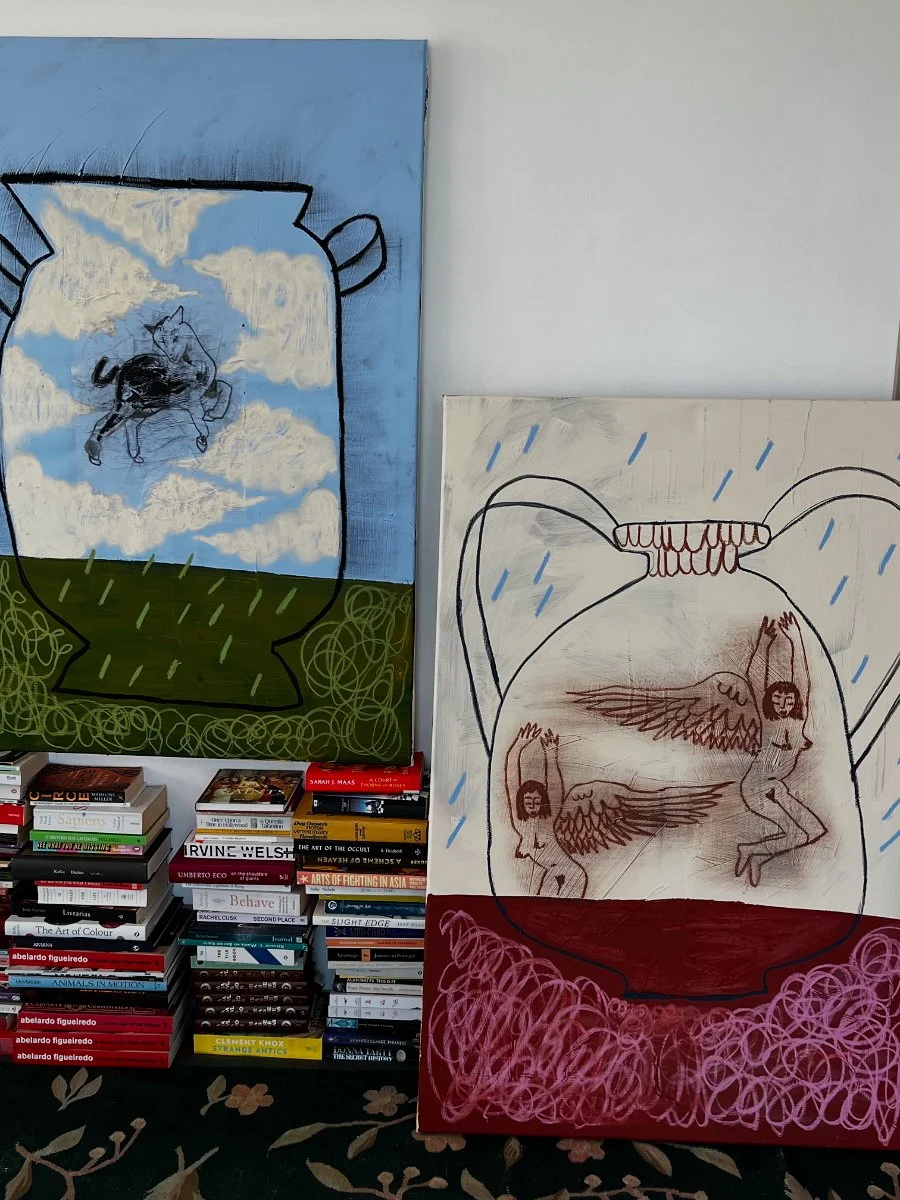 Image 2 of 4
 Image 3 of 4
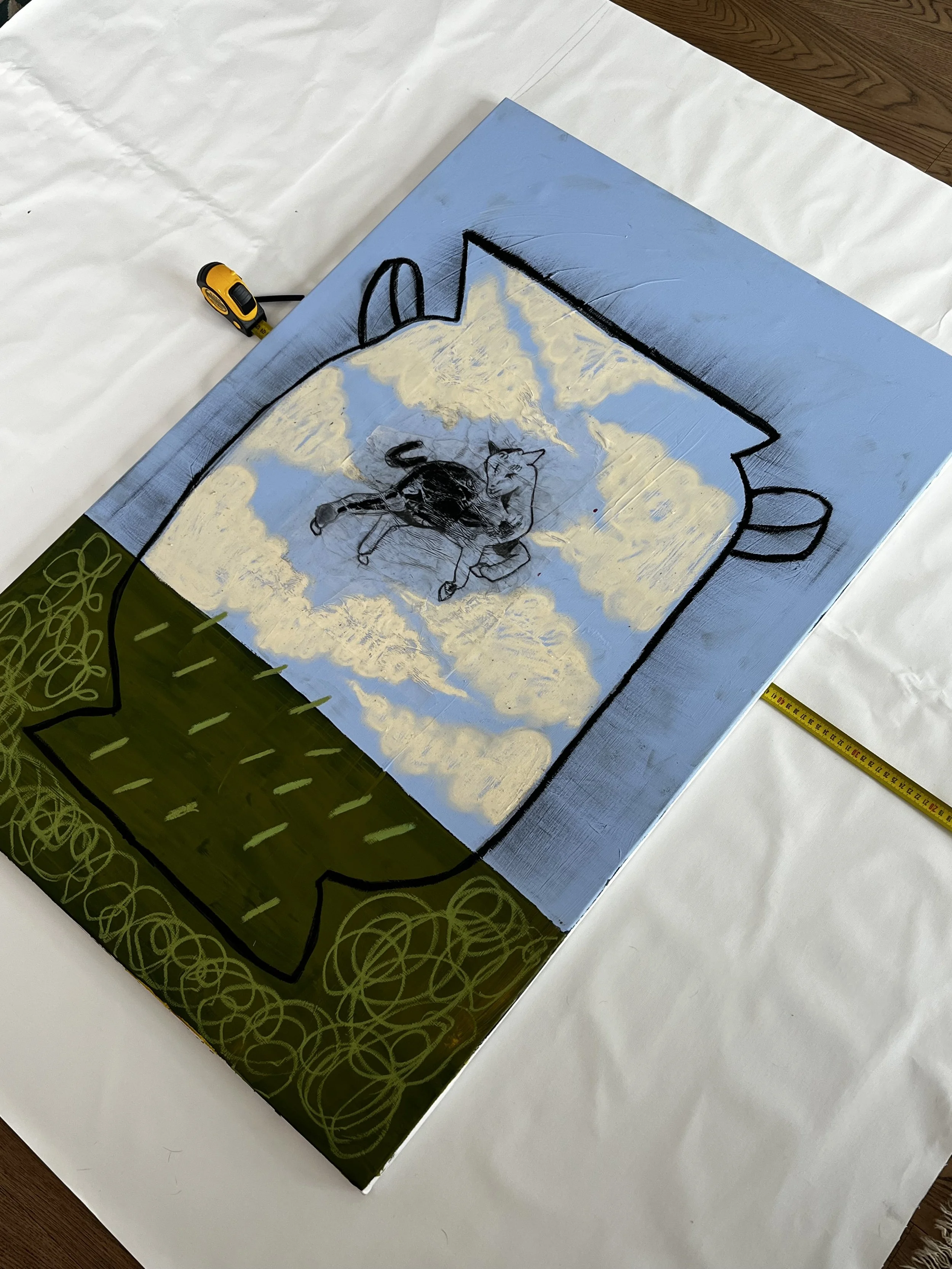 Image 4 of 4
SWEET DREAMS
120 × 80cm
47.2 × 31.5in
Acrylic, oil pastels, and collage on canvas. Shipped unframed. Fully insured shipping via DHL.
This sale is active only during February 1–28
All sales are final. This is a limited studio sale with discounted pricing. Shipping is scheduled for the first week of March and is not immediate. No refunds, returns, or exchanges will be accepted.
Dreams have always felt to me like secret containers, like glass jars filled with images that feel closer to memory than imagination. They hold what I can’t carry in my waking life, fragments too delicate to survive in the daylight, like fantasies I might not have the courage to consciously act on, visions with meanings that will only reveal themselves to me under analysis but that, at the same time, would slip through my fingers if I tried to grasp them too tightly.
I guess my relationship with painting is rather similar…
Both are vessels for the ephemeral. Both preserve what on its own would otherwise dissolve (dream/ideas). And yet, the moment we manage to hold these fleeting little things for long enough, they reveal themselves in so many unexpected ways.
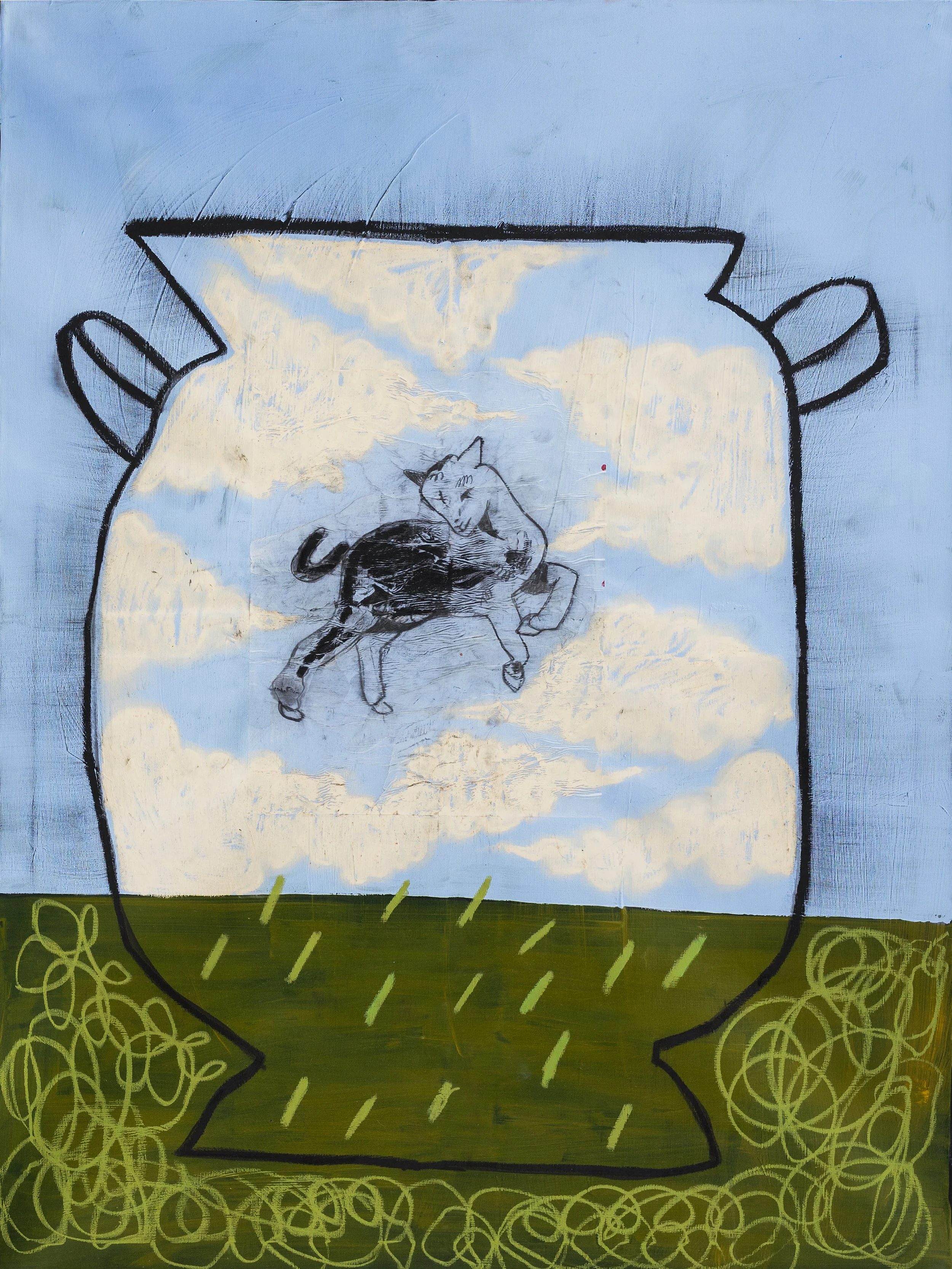
Sweet Dreams was painted with this sense of containment in mind. At first it appeared to me as an ordinary composition: another vase, an animal, a stretch of sky. But, like with dreams, the more I looked at it, the deeper I could see. I am used to painting vases that hold flowers, objects we see in our everyday life. This one though, this one is different, it is not rooted in the earth, it is not real, it feels fragile, like a soap bubble, as if the smallest touch might dissolve it.
The vase is boldly outlined, wide bodied, lines made with black oil. But despite all that, and despite its fragile aura, its belly holds something big, not water or flowers or offerings to the dead. Inside it’s boundaries, this vase holds the drifting clouds, a dreamscape. This is a vessel for the ungraspable.
What does it mean for the unreal to hold it’s own reality?
At the center we see the lamb. Black and white mid movement, suspended as though caught between waking up and falling asleep.
The lamb I s a very old symbol. It is the sacrificial figure in classic catholic myth: the innocence destroyed so that gentleness can triumph over sin and we may live. It is also the emblem of Arcadia, the ancient greek pastoral paradise. This is a creature of meadows and lullabies, forever liked with the ritual of counting sheep, and the soft embrace of sleep. This animal is innocence embodied: too gentle to survive without care but too central to be forgotten or cast aside.
Suspended in the clouds, the lamb becomes all of these symbols at once: sacrifice lifted from the altar, the innocence raised towards the sky, and the memories that come to you in the brink of sleep. She carries this tenderness upwards with her, where no hand can reach it. The lamb in the vase is both fragile and eternal.
The clouds, like dreams, resist being fixed in place. Yet here I hold them, for a moment, my hands become the walls of the vase. This painting became, for me, a way to give form to what otherwise would vanish, a way for me to hold the unholdable.
The decision to paint all of this using a very simple color palette was obvious. Blue dominates this world I created. Blue, the color of distance, of things we long for but cannot touch, But here we see a softer kind of blue, not the grief stricken pale shade, but the blue from lullabies, a blue that brings comfort and sleep, a shade that of the kind of absence that soothes, that has a distance that is comforting.
Beneath the vase we have green. Scribbled and tangled. The opposite of the sky above, messy, earthy, real. Against this ground the vase becomes a lens, a way of seeing the world. Though this lens, the ordinary is re-shaped, a cloudless sky becomes filled with dreams.
Perhaps this is the true purpose of a dream: to hold intact what cannot survive in the messy and tangled waking life. To cradle this innocence, protect it, from the, sometimes overbearing, weight of reality.
I think about this often.
For a long time, most of my life really, I remembered my dreams vividly, strange, luminous narratives that lived with me for a long time after waking up. My dreams always tasted like memories. As a matter of fact, for years it was very difficult for me to discern the two, separate that was a memory from what was a dream. Recently however there has been a fog over my vase shaped lenses: my dreams have become distant, harder to recall, dissolving before I can grasp them.
Painting becomes a way of holding onto that dissolution. Like a way of saying: even if I forget, this vessel, this painting, remembers. Writting this now I see another metaphor forming, meeting in a place between the painting and the place I currently find myself in: I can now also see the vase as a body, my body. Even if rationally I might not remember my dreams, the visions or their meanings, my body does.
The lamb, then, is not only a symbol of myth and innocence, but also a part of myself I don’t want to lose sight of. The part that remains soft, that lives in this in between space, inside the soap bubble. I believe dreams are what protects this part of us, and reminds us that it exists when we get too close to forgetting it.
That is what I meant when I say that dreams are like a lens. They may not be real in the way that the grass is real, but their unreality gives contrast to the reality of our waking life. And we as simple human beings, can only experience life through contrast. So by drifting and showing us the impossible, dreams sharpen our sense of what in fact is possible. By showing us innocence preserved for a moment, pure unaltered imagination, raw feelings, archetypes and secrets, dreams remind us how necessary these things are. Without them reality becomes pointless.
Dreams make the world more real precisely by being unreal.
Sweet Dreams is an ode to this paradox, (Sweet Dreams is also an offering to the dream gods so they would please lift the fog that keeps me from having access to my dreams) it is an ode to the lamb in the clouds, the vase that becomes the lens that allows us to see the “unreal”.
In the end, I think dreams exist so that we can see that beauty and sensibility do not need to endure in our physical reality in order for them to matter. A feeling does not need to have an image, much less an action in order to be remembered. It is there, where we see it or not, it is there. Fragility vulnerability are preserving, but eventually, the lamb in the soap bubble will dissolve, the clouds will ship, the lenses will fog, and we will wake up.
120 × 80cm
47.2 × 31.5in
Acrylic, oil pastels, and collage on canvas. Shipped unframed. Fully insured shipping via DHL.
This sale is active only during February 1–28
All sales are final. This is a limited studio sale with discounted pricing. Shipping is scheduled for the first week of March and is not immediate. No refunds, returns, or exchanges will be accepted.
Dreams have always felt to me like secret containers, like glass jars filled with images that feel closer to memory than imagination. They hold what I can’t carry in my waking life, fragments too delicate to survive in the daylight, like fantasies I might not have the courage to consciously act on, visions with meanings that will only reveal themselves to me under analysis but that, at the same time, would slip through my fingers if I tried to grasp them too tightly.
I guess my relationship with painting is rather similar…
Both are vessels for the ephemeral. Both preserve what on its own would otherwise dissolve (dream/ideas). And yet, the moment we manage to hold these fleeting little things for long enough, they reveal themselves in so many unexpected ways.
Sweet Dreams was painted with this sense of containment in mind. At first it appeared to me as an ordinary composition: another vase, an animal, a stretch of sky. But, like with dreams, the more I looked at it, the deeper I could see. I am used to painting vases that hold flowers, objects we see in our everyday life. This one though, this one is different, it is not rooted in the earth, it is not real, it feels fragile, like a soap bubble, as if the smallest touch might dissolve it.
The vase is boldly outlined, wide bodied, lines made with black oil. But despite all that, and despite its fragile aura, its belly holds something big, not water or flowers or offerings to the dead. Inside it’s boundaries, this vase holds the drifting clouds, a dreamscape. This is a vessel for the ungraspable.
What does it mean for the unreal to hold it’s own reality?
At the center we see the lamb. Black and white mid movement, suspended as though caught between waking up and falling asleep.
The lamb I s a very old symbol. It is the sacrificial figure in classic catholic myth: the innocence destroyed so that gentleness can triumph over sin and we may live. It is also the emblem of Arcadia, the ancient greek pastoral paradise. This is a creature of meadows and lullabies, forever liked with the ritual of counting sheep, and the soft embrace of sleep. This animal is innocence embodied: too gentle to survive without care but too central to be forgotten or cast aside.
Suspended in the clouds, the lamb becomes all of these symbols at once: sacrifice lifted from the altar, the innocence raised towards the sky, and the memories that come to you in the brink of sleep. She carries this tenderness upwards with her, where no hand can reach it. The lamb in the vase is both fragile and eternal.
The clouds, like dreams, resist being fixed in place. Yet here I hold them, for a moment, my hands become the walls of the vase. This painting became, for me, a way to give form to what otherwise would vanish, a way for me to hold the unholdable.
The decision to paint all of this using a very simple color palette was obvious. Blue dominates this world I created. Blue, the color of distance, of things we long for but cannot touch, But here we see a softer kind of blue, not the grief stricken pale shade, but the blue from lullabies, a blue that brings comfort and sleep, a shade that of the kind of absence that soothes, that has a distance that is comforting.
Beneath the vase we have green. Scribbled and tangled. The opposite of the sky above, messy, earthy, real. Against this ground the vase becomes a lens, a way of seeing the world. Though this lens, the ordinary is re-shaped, a cloudless sky becomes filled with dreams.
Perhaps this is the true purpose of a dream: to hold intact what cannot survive in the messy and tangled waking life. To cradle this innocence, protect it, from the, sometimes overbearing, weight of reality.
I think about this often.
For a long time, most of my life really, I remembered my dreams vividly, strange, luminous narratives that lived with me for a long time after waking up. My dreams always tasted like memories. As a matter of fact, for years it was very difficult for me to discern the two, separate that was a memory from what was a dream. Recently however there has been a fog over my vase shaped lenses: my dreams have become distant, harder to recall, dissolving before I can grasp them.
Painting becomes a way of holding onto that dissolution. Like a way of saying: even if I forget, this vessel, this painting, remembers. Writting this now I see another metaphor forming, meeting in a place between the painting and the place I currently find myself in: I can now also see the vase as a body, my body. Even if rationally I might not remember my dreams, the visions or their meanings, my body does.
The lamb, then, is not only a symbol of myth and innocence, but also a part of myself I don’t want to lose sight of. The part that remains soft, that lives in this in between space, inside the soap bubble. I believe dreams are what protects this part of us, and reminds us that it exists when we get too close to forgetting it.
That is what I meant when I say that dreams are like a lens. They may not be real in the way that the grass is real, but their unreality gives contrast to the reality of our waking life. And we as simple human beings, can only experience life through contrast. So by drifting and showing us the impossible, dreams sharpen our sense of what in fact is possible. By showing us innocence preserved for a moment, pure unaltered imagination, raw feelings, archetypes and secrets, dreams remind us how necessary these things are. Without them reality becomes pointless.
Dreams make the world more real precisely by being unreal.
Sweet Dreams is an ode to this paradox, (Sweet Dreams is also an offering to the dream gods so they would please lift the fog that keeps me from having access to my dreams) it is an ode to the lamb in the clouds, the vase that becomes the lens that allows us to see the “unreal”.
In the end, I think dreams exist so that we can see that beauty and sensibility do not need to endure in our physical reality in order for them to matter. A feeling does not need to have an image, much less an action in order to be remembered. It is there, where we see it or not, it is there. Fragility vulnerability are preserving, but eventually, the lamb in the soap bubble will dissolve, the clouds will ship, the lenses will fog, and we will wake up.