
 Image 1 of 3
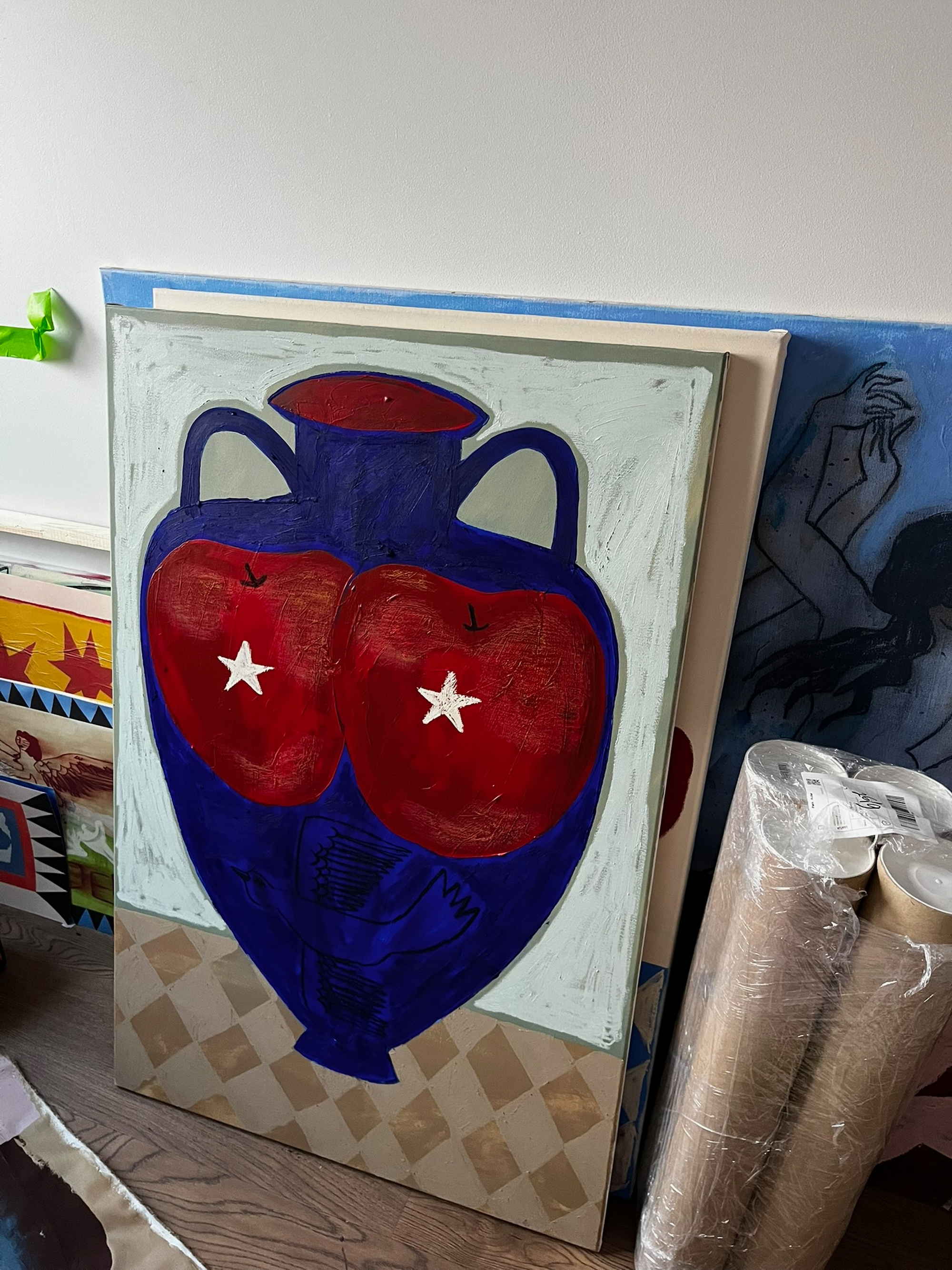 Image 2 of 3
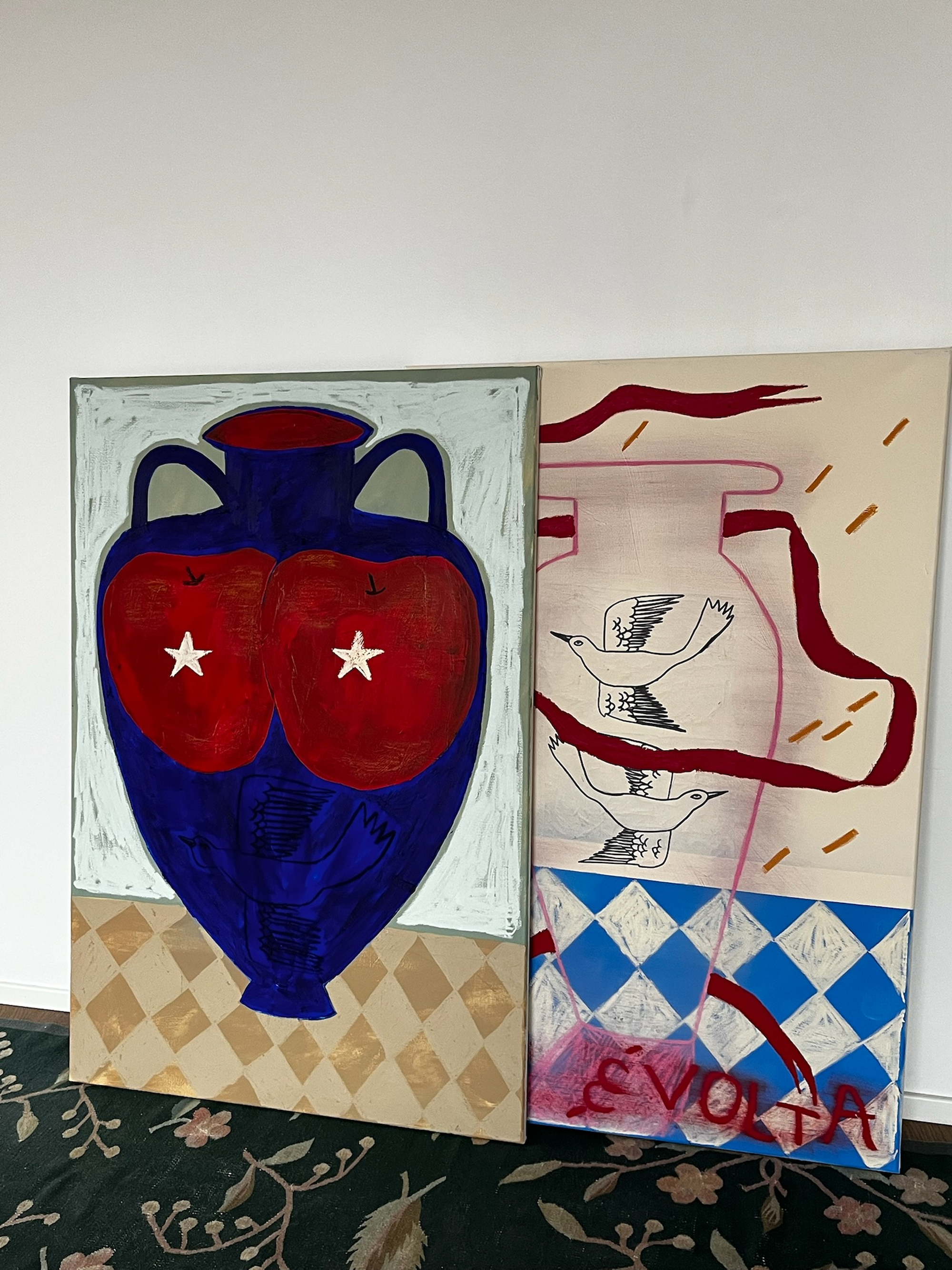 Image 3 of 3
JUGS
120 × 80 cm
45 × 31.5 in
Acrylic, oil pastels, and collage on canvas. Shipped unframed. Fully insured shipping via DHL.
This sale is active only during February 1–28
All sales are final. This is a limited studio sale with discounted pricing. Shipping is scheduled for the first week of March and is not immediate. No refunds, returns, or exchanges will be accepted.
JUGS - notes on abundance
I have been thinking about abundance, and about how uneasy it makes me.
Not the lack of it, that hunger I understand well, but the moment when something arrives already full. When nothing is missing. When there is no clear task except to receive. There is a particular vulnerability in that position, one I was not taught how to inhabit. To open the hands without knowing whether they are strong enough to hold what is placed there.
Abundance asks for a kind of trust that feels almost reckless.
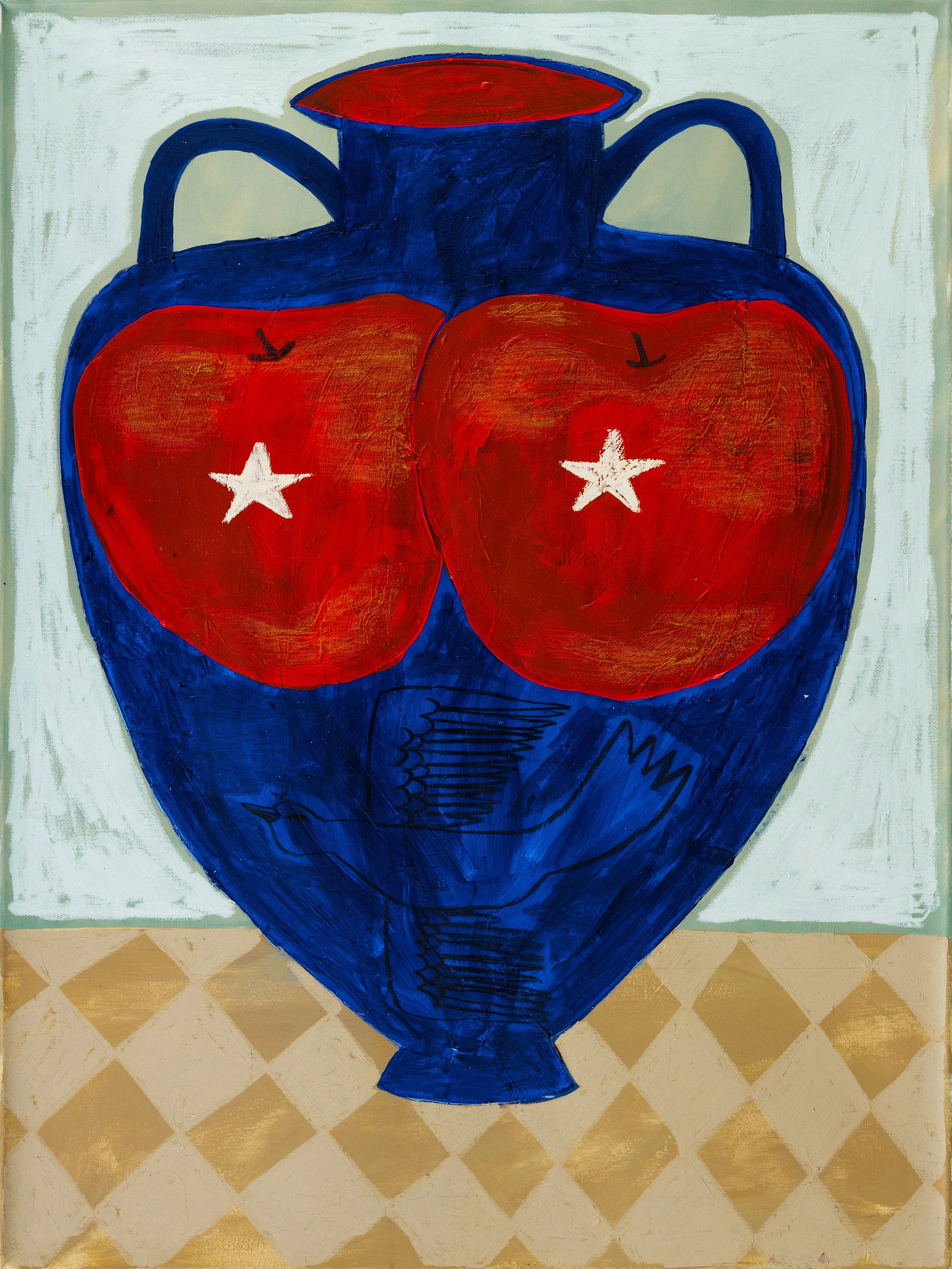
I see this most clearly in the amphora. Its body swollen, rounded, holding two red apples so ripe they seem to strain against the vessel that contains them. The amphora does not reach for anything. It does not move. It simply stands, full, offering what it already carries.
There is something unsettling about that fullness. It exposes the fear of insufficiency. Not the fear of not having enough, but the fear of being unable to hold what is given. Of spilling it. Of wasting it. Of being revealed as unprepared.
We are taught how to desire, how to strive, how to endure scarcity. But abundance requires a different kind of posture. It asks you to stay open without bracing. To resist the instinct to tighten, to measure, to earn again what has already arrived.
The apples inside the amphora feel like an inheritance just as much as an invitation. They are not demanded. They are not negotiated. They simply exist. Red, heavy, undeniable. Their presence does not depend on my readiness.
This is what unsettles me most: abundance does not care whether I feel worthy of it.
I notice how quickly the mind rushes in at moments like this. How it begins to calculate… How long will this last? What will it cost? What am I expected to give in return? Will it be taken away? As if fullness must always be followed by loss. As if receiving without consequence is a kind of naivety.
But something in me, in this painting begins to refuses that logic. Here there is an offer without urgency. There is no sense that time is running out, no insistence that the apples be taken before they rot. The gesture is quiet, almost indifferent. Abundance here is not dramatic. It does not announce itself. It simply waits.
I think this is what makes it so difficult to accept.
To receive abundance requires stillness. It requires staying long enough to feel the discomfort rise, the old habits of self-protection, the inherited suspicion of ease. It asks for a softness that feels exposed, especially to someone who learned early how to survive through vigilance.
I recognize this tension in my body. The way my shoulders lift when something good arrives. The way I prepare, instinctively, for it to be taken away. There is a part of me that would rather remain in longing than risk the vulnerability of having.
The apples, swollen and red, feel almost excessive. Two instead of one. More than necessary. They echo something I have been slowly learning: that abundance is rarely neat. It overflows. It presses against its container. It reveals the limits of what we think we can hold.
The amphora does not apologize for this. It does not try to shrink itself. Its fullness is not a provocation, only a fact.
I find myself returning to this image when I think about receiving. Receiving love, opportunity, care, nourishment. All the things that arrive quietly, without drama, and wait to see whether I will make room for them. Whether I will meet them with suspicion or with trust.
Abundance, I am learning, is not something you chase. It is something you allow to remain.
There is no urgency here. There never is. No countdown, no demand for immediate action. The offering exists whether I accept it or not. The apples will stay red. The vessel will remain full. The invitation does not expire.
This is perhaps the most radical thing about abundance: it does not need to be proven. It does not need to be justified. It does not collapse if I hesitate.
To sit with abundance is to confront the places where I have learned to equate safety with scarcity. To notice how much effort goes into maintaining a familiar lack, simply because it feels predictable.
The amphora teaches me another way of knowing. One that trusts fullness without possession. One that understands that holding does not mean controlling. That receiving does not mean owing.
In the end, abundance asks for presence, not action. It asks me to stay with the discomfort long enough for it to soften into recognition. To see that what is being offered is not a test, nor a trap, nor a debt, but a condition that already exists.
The apples are there. The vessel is full.
Whether I welcome it or not, abundance has already arrived.JUGS - notes on abundance
I have been thinking about abundance, and about how uneasy it makes me.
Not the lack of it, that hunger I understand well, but the moment when something arrives already full. When nothing is missing. When there is no clear task except to receive. There is a particular vulnerability in that position, one I was not taught how to inhabit. To open the hands without knowing whether they are strong enough to hold what is placed there.
Abundance asks for a kind of trust that feels almost reckless.
I see this most clearly in the amphora. Its body swollen, rounded, holding two red apples so ripe they seem to strain against the vessel that contains them. The amphora does not reach for anything. It does not move. It simply stands, full, offering what it already carries.
There is something unsettling about that fullness. It exposes the fear of insufficiency. Not the fear of not having enough, but the fear of being unable to hold what is given. Of spilling it. Of wasting it. Of being revealed as unprepared.
We are taught how to desire, how to strive, how to endure scarcity. But abundance requires a different kind of posture. It asks you to stay open without bracing. To resist the instinct to tighten, to measure, to earn again what has already arrived.
The apples inside the amphora feel like an inheritance just as much as an invitation. They are not demanded. They are not negotiated. They simply exist. Red, heavy, undeniable. Their presence does not depend on my readiness.
This is what unsettles me most: abundance does not care whether I feel worthy of it.
I notice how quickly the mind rushes in at moments like this. How it begins to calculate… How long will this last? What will it cost? What am I expected to give in return? Will it be taken away? As if fullness must always be followed by loss. As if receiving without consequence is a kind of naivety.
But something in me, in this painting begins to refuses that logic. Here there is an offer without urgency. There is no sense that time is running out, no insistence that the apples be taken before they rot. The gesture is quiet, almost indifferent. Abundance here is not dramatic. It does not announce itself. It simply waits.
I think this is what makes it so difficult to accept.
To receive abundance requires stillness. It requires staying long enough to feel the discomfort rise, the old habits of self-protection, the inherited suspicion of ease. It asks for a softness that feels exposed, especially to someone who learned early how to survive through vigilance.
I recognize this tension in my body. The way my shoulders lift when something good arrives. The way I prepare, instinctively, for it to be taken away. There is a part of me that would rather remain in longing than risk the vulnerability of having.
The apples, swollen and red, feel almost excessive. Two instead of one. More than necessary. They echo something I have been slowly learning: that abundance is rarely neat. It overflows. It presses against its container, against you, against me. It reveals the limits of what we think we can hold.
The amphora does not apologize for this. It does not try to shrink itself. Its fullness is not a provocation, only a fact.
I find myself returning to this image when I think about receiving. Receiving love, opportunity, care, nourishment. All the things that arrive quietly, without drama, and wait to see whether I will make room for them. Whether I will meet them with suspicion or with trust.
Abundance, I am learning, is not something you chase. It is something you allow to remain.
There is no urgency here. There never is. No countdown, no demand for immediate action. The offering exists whether I accept it or not. The apples will stay red. The vessel will remain full. The invitation does not expire.
This is perhaps the most radical thing about abundance: it does not need to be proven. It does not need to be justified. It does not collapse if I hesitate.
To sit with abundance is to confront the places where I have learned to equate safety with scarcity. To notice how much effort goes into maintaining a familiar lack, simply because it feels predictable.
The amphora teaches me another way of knowing. One that trusts fullness without possession. One that understands that holding does not mean controlling. That receiving does not mean owing.
In the end, abundance asks for presence, not action. It asks me to stay with the discomfort long enough for it to soften into recognition. To see that what is being offered is not a test, nor a trap, nor a debt, but a condition that already exists.
The apples are there. The vessel is full.
Whether I welcome it or not, abundance has already arrived.
120 × 80 cm
45 × 31.5 in
Acrylic, oil pastels, and collage on canvas. Shipped unframed. Fully insured shipping via DHL.
This sale is active only during February 1–28
All sales are final. This is a limited studio sale with discounted pricing. Shipping is scheduled for the first week of March and is not immediate. No refunds, returns, or exchanges will be accepted.
JUGS - notes on abundance
I have been thinking about abundance, and about how uneasy it makes me.
Not the lack of it, that hunger I understand well, but the moment when something arrives already full. When nothing is missing. When there is no clear task except to receive. There is a particular vulnerability in that position, one I was not taught how to inhabit. To open the hands without knowing whether they are strong enough to hold what is placed there.
Abundance asks for a kind of trust that feels almost reckless.
I see this most clearly in the amphora. Its body swollen, rounded, holding two red apples so ripe they seem to strain against the vessel that contains them. The amphora does not reach for anything. It does not move. It simply stands, full, offering what it already carries.
There is something unsettling about that fullness. It exposes the fear of insufficiency. Not the fear of not having enough, but the fear of being unable to hold what is given. Of spilling it. Of wasting it. Of being revealed as unprepared.
We are taught how to desire, how to strive, how to endure scarcity. But abundance requires a different kind of posture. It asks you to stay open without bracing. To resist the instinct to tighten, to measure, to earn again what has already arrived.
The apples inside the amphora feel like an inheritance just as much as an invitation. They are not demanded. They are not negotiated. They simply exist. Red, heavy, undeniable. Their presence does not depend on my readiness.
This is what unsettles me most: abundance does not care whether I feel worthy of it.
I notice how quickly the mind rushes in at moments like this. How it begins to calculate… How long will this last? What will it cost? What am I expected to give in return? Will it be taken away? As if fullness must always be followed by loss. As if receiving without consequence is a kind of naivety.
But something in me, in this painting begins to refuses that logic. Here there is an offer without urgency. There is no sense that time is running out, no insistence that the apples be taken before they rot. The gesture is quiet, almost indifferent. Abundance here is not dramatic. It does not announce itself. It simply waits.
I think this is what makes it so difficult to accept.
To receive abundance requires stillness. It requires staying long enough to feel the discomfort rise, the old habits of self-protection, the inherited suspicion of ease. It asks for a softness that feels exposed, especially to someone who learned early how to survive through vigilance.
I recognize this tension in my body. The way my shoulders lift when something good arrives. The way I prepare, instinctively, for it to be taken away. There is a part of me that would rather remain in longing than risk the vulnerability of having.
The apples, swollen and red, feel almost excessive. Two instead of one. More than necessary. They echo something I have been slowly learning: that abundance is rarely neat. It overflows. It presses against its container. It reveals the limits of what we think we can hold.
The amphora does not apologize for this. It does not try to shrink itself. Its fullness is not a provocation, only a fact.
I find myself returning to this image when I think about receiving. Receiving love, opportunity, care, nourishment. All the things that arrive quietly, without drama, and wait to see whether I will make room for them. Whether I will meet them with suspicion or with trust.
Abundance, I am learning, is not something you chase. It is something you allow to remain.
There is no urgency here. There never is. No countdown, no demand for immediate action. The offering exists whether I accept it or not. The apples will stay red. The vessel will remain full. The invitation does not expire.
This is perhaps the most radical thing about abundance: it does not need to be proven. It does not need to be justified. It does not collapse if I hesitate.
To sit with abundance is to confront the places where I have learned to equate safety with scarcity. To notice how much effort goes into maintaining a familiar lack, simply because it feels predictable.
The amphora teaches me another way of knowing. One that trusts fullness without possession. One that understands that holding does not mean controlling. That receiving does not mean owing.
In the end, abundance asks for presence, not action. It asks me to stay with the discomfort long enough for it to soften into recognition. To see that what is being offered is not a test, nor a trap, nor a debt, but a condition that already exists.
The apples are there. The vessel is full.
Whether I welcome it or not, abundance has already arrived.JUGS - notes on abundance
I have been thinking about abundance, and about how uneasy it makes me.
Not the lack of it, that hunger I understand well, but the moment when something arrives already full. When nothing is missing. When there is no clear task except to receive. There is a particular vulnerability in that position, one I was not taught how to inhabit. To open the hands without knowing whether they are strong enough to hold what is placed there.
Abundance asks for a kind of trust that feels almost reckless.
I see this most clearly in the amphora. Its body swollen, rounded, holding two red apples so ripe they seem to strain against the vessel that contains them. The amphora does not reach for anything. It does not move. It simply stands, full, offering what it already carries.
There is something unsettling about that fullness. It exposes the fear of insufficiency. Not the fear of not having enough, but the fear of being unable to hold what is given. Of spilling it. Of wasting it. Of being revealed as unprepared.
We are taught how to desire, how to strive, how to endure scarcity. But abundance requires a different kind of posture. It asks you to stay open without bracing. To resist the instinct to tighten, to measure, to earn again what has already arrived.
The apples inside the amphora feel like an inheritance just as much as an invitation. They are not demanded. They are not negotiated. They simply exist. Red, heavy, undeniable. Their presence does not depend on my readiness.
This is what unsettles me most: abundance does not care whether I feel worthy of it.
I notice how quickly the mind rushes in at moments like this. How it begins to calculate… How long will this last? What will it cost? What am I expected to give in return? Will it be taken away? As if fullness must always be followed by loss. As if receiving without consequence is a kind of naivety.
But something in me, in this painting begins to refuses that logic. Here there is an offer without urgency. There is no sense that time is running out, no insistence that the apples be taken before they rot. The gesture is quiet, almost indifferent. Abundance here is not dramatic. It does not announce itself. It simply waits.
I think this is what makes it so difficult to accept.
To receive abundance requires stillness. It requires staying long enough to feel the discomfort rise, the old habits of self-protection, the inherited suspicion of ease. It asks for a softness that feels exposed, especially to someone who learned early how to survive through vigilance.
I recognize this tension in my body. The way my shoulders lift when something good arrives. The way I prepare, instinctively, for it to be taken away. There is a part of me that would rather remain in longing than risk the vulnerability of having.
The apples, swollen and red, feel almost excessive. Two instead of one. More than necessary. They echo something I have been slowly learning: that abundance is rarely neat. It overflows. It presses against its container, against you, against me. It reveals the limits of what we think we can hold.
The amphora does not apologize for this. It does not try to shrink itself. Its fullness is not a provocation, only a fact.
I find myself returning to this image when I think about receiving. Receiving love, opportunity, care, nourishment. All the things that arrive quietly, without drama, and wait to see whether I will make room for them. Whether I will meet them with suspicion or with trust.
Abundance, I am learning, is not something you chase. It is something you allow to remain.
There is no urgency here. There never is. No countdown, no demand for immediate action. The offering exists whether I accept it or not. The apples will stay red. The vessel will remain full. The invitation does not expire.
This is perhaps the most radical thing about abundance: it does not need to be proven. It does not need to be justified. It does not collapse if I hesitate.
To sit with abundance is to confront the places where I have learned to equate safety with scarcity. To notice how much effort goes into maintaining a familiar lack, simply because it feels predictable.
The amphora teaches me another way of knowing. One that trusts fullness without possession. One that understands that holding does not mean controlling. That receiving does not mean owing.
In the end, abundance asks for presence, not action. It asks me to stay with the discomfort long enough for it to soften into recognition. To see that what is being offered is not a test, nor a trap, nor a debt, but a condition that already exists.
The apples are there. The vessel is full.
Whether I welcome it or not, abundance has already arrived.